Every year, millions of pilgrims travel to Tirupati with their hearts set on seeking the blessings of Lord Venkateswara at Tirumala. But tucked right in the heart of Tirupati city stands a temple that many devotees walk past without fully understanding its depth — Sri Govindaraja Swamy Temple. Ancient, magnificent, and deeply intertwined with the legend of Tirumala itself, this temple deserves far more than a passing glance.
Whether you’re a first-time visitor to Tirupati or a seasoned pilgrim who’s been dozens of times, this guide walks you through everything you need to know — the history, the mythology, the architecture, darshan timings, sevas, festivals, and practical travel tips.
What Is Sri Govindaraja Swamy Temple?
Sri Govindaraja Swamy Temple is one of the oldest and largest Vaishnavite temples in Andhra Pradesh, located in the centre of Tirupati city. Consecrated by the revered philosopher-saint Sri Ramanujacharya in 1130 AD, the temple is dedicated to Lord Vishnu in his yoga nidra (divine reclining) form — known here as Govindaraja Swamy.
The presiding deity lies in a serene reclining posture, facing east, with his right hand under his head and his left hand resting over his body. His divine consorts Sridevi and Bhudevi are seated at his feet. This breathtaking form of the Lord, enshrined in a majestic Dravidian-style complex, draws lakhs of devotees every year for Tirupati temple darshan.
Table of Contents
The History: Nearly 900 Years of Devotion
The story of this temple is as fascinating as the legends it holds.
The site originally housed Sri Parthasarathi (Lord Krishna) as the main deity, and the temple was known as the Parthasarathi Swamy Temple well into the 12th century. When Shaivite king Kulothunga Chola II forcibly removed the Govindaraja deity from the famous temple in Chidambaram, devotees safeguarded the processional idol and brought it to Tirupati.
Saint Ramanujacharya, recognising the importance of this deity, consecrated Govindaraja as the presiding deity here in 1130 AD. Inscriptions from as early as 1235 AD during the reign of Chola King Raja Raja III confirm the temple’s growing stature. By 1506 AD, during the reign of the Vijayanagara dynasty, the temple gained even greater prominence — with successive rulers contributing to its expansion, decoration, and maintenance.
Today, the temple is administered by the Tirumala Tirupati Devasthanams (TTD), following Vaikhanasa Agama worship traditions.
Why Is This Temple So Sacred? The Mythological Connection
Here’s what makes Sri Govindaraja Swamy Temple uniquely special among all temples in Tirupati — the divine bond between Govindaraja Swamy and Lord Venkateswara.
According to Hindu mythology, Govindaraja Swamy is the elder brother of Lord Venkateswara (Balaji) of Tirumala. When Lord Venkateswara decided to marry Goddess Padmavathi, the celestial wedding required enormous wealth. Govindaraja Swamy stepped in as the caretaker, borrowing a massive amount from Kubera (the treasurer of the gods) to fund one of the grandest weddings in all of Hindu mythology.
The loan, it is said, is still being repaid by Lord Venkateswara — which is why countless devotees offer gold and wealth at Tirumala even today. In this temple, it is believed that Govindaraja Swamy himself is collecting interest on that amount, represented symbolically by a brass measure kept near the deity.
This connection makes a visit to the Govindaraja Perumal Temple an essential, almost inseparable part of any Tirupati pilgrimage.
Architecture: A Masterpiece in Stone
The temple complex is a magnificent example of South Indian Dravidian architecture at its finest.
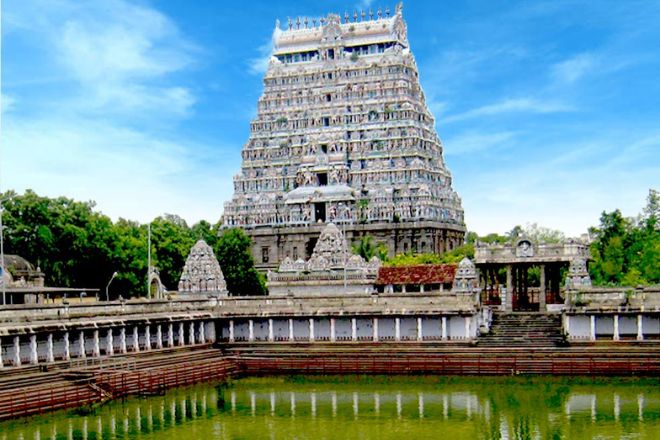
The seven-storeyed Rajagopuram on the eastern entrance — completed in 1628 AD — towers 50 metres high and is visible from almost anywhere in the city. Its surface is adorned with intricate sculptures depicting scenes from the Ramayana, the Bhagavatam, and Lord Krishna’s life. The innermost gopuram dates back to the 14th century, making it one of the oldest standing structures in the complex.
Inside, the temple houses several important shrines:
- Sri Govindaraja Swamy — the main deity in reclining yoga nidra posture
- Sri Parthasarathi — Lord Krishna with his consorts Rukmini and Satyabhama
- Goddess Lakshmi — in a separate shrine to the left of the main gopuram
- Smaller shrines dedicated to Sri Andal, Ramanuja, Vedanta Desikar, Alwar saints, Vyasaraya Anjaneyaswami, Chakrathalwar, and more
One unique detail worth knowing: abhishekam (ritual bathing) is not performed on the main idol, as the presiding deity is believed to be made of clay/sand. Instead, ablutions are performed on a smaller idol kept for this purpose.
Sri Govindaraja Swamy Temple Darshan Timings
Planning your visit well in advance makes all the difference. The temple follows a fixed daily schedule throughout the year, with timing adjustments only during Brahmotsavam and major festivals.
Daily Darshan Timings:
| Session | Timings |
|---|---|
| Morning Session | 5:00 AM – 12:30 PM |
| Afternoon Session | 1:15 PM – 4:45 PM |
| Evening Session | 6:00 PM – 9:30 PM |
The temple opens with Suprabhata Seva at 5:00 AM and closes with Ekantha Seva around 9:30 PM. A free small laddu prasadam is distributed to devotees every morning between 5:00 AM and 8:45 AM, making the early morning session especially popular.
Archana Anantara Darshan is held from 8:00 AM to 8:45 AM, ideal for those seeking a more focused darshan experience.
Note: Timings change during Brahmotsavam and other festival days — always confirm with TTD closer to your visit.
Sevas & Special Rituals
The temple conducts a range of sevas (worship services) in keeping with the Vaikhanasa Agama traditions. Special sevas can be booked through the official TTD website: ttdevasthanams.ap.gov.in
The temple also serves Annaprasadam (free meals) to all devotees:
- Lunch: 11:30 AM – 2:30 PM
- Dinner: 7:30 PM – 9:30 PM
Festivals at Sri Govindaraja Swamy Temple
The festival calendar here is rich and vibrant. Two festivals in particular draw enormous crowds every year:
Brahmotsavam — held during the month of Vaisakha (May–June), this is the grandest annual festival at the temple. For several days, the deity is taken out in colourful processions on different vahanas (divine vehicles) through the streets. The atmosphere is electric, with devotional music filling every corner of the city.
Float Festival (Teppotsavam) — celebrated in February–March, this visually stunning festival involves the deity being placed on a beautifully decorated float in a large water tank. Thousands of devotees gather to witness the ceremony.
Other important observances include Vaikuntha Ekadasi, Pavitrotsavam, and the celebrations coinciding with Rathotsavam (Chariot Festival). If you’re planning a Tirupati pilgrimage, timing your visit around one of these festivals transforms the experience entirely.
Govindaraja Swamy Temple Museum
A relatively recent addition to the complex is the Govindaraja Swamy Temple Museum — a treasure trove for history lovers. The museum houses ancient artefacts, old currency, manuscripts, and inscriptions that trace the temple’s evolution across centuries. Walking through its displays is like stepping through a living timeline of South Indian religious history.
Dress Code
The temple follows a conservative dress code:
- Men: Dhoti or traditional attire preferred; trousers are permitted
- Women: Saree, salwar kameez, or traditional attire
- Shorts, sleeveless tops, and western casuals are not allowed inside the sanctum
How to Reach Sri Govindaraja Swamy Temple
The temple sits in the heart of Tirupati city, making it easily accessible from every direction.
By Train: Tirupati Railway Station is less than 1 km from the temple — it’s practically within walking distance for those who prefer it.
By Air: The nearest airport is Renigunta Airport (Tirupati Airport), approximately 15 km away. A taxi from the airport takes around 20–25 minutes.
By Road: The temple is well-connected to major cities — Hyderabad (~570 km), Bengaluru (~250 km), and Chennai (~135 km). The Tirupati bus station is just 2 km away.
By Taxi: The most comfortable and efficient way to travel — especially if you’re combining your visit with Tirumala darshan, Padmavathi Temple at Tiruchanur, and other nearby temples.
Plan Your Complete Tirupati Pilgrimage with Ease
A Tirupati pilgrimage is rarely just one temple — it’s a spiritual journey spanning Sri Govindaraja Swamy Temple, Tirumala Venkateswara Temple, Padmavathi Ammavari Temple, Sri Kapileswara Swamy Temple, and several more sacred sites spread across the hills and the city. Managing all of this — timings, queues, darshan slots, transportation — can feel overwhelming, especially if you’re visiting for the first time.
That’s where Tirupati Balaji Tours & Travels comes in.
We specialise in making your entire Tirupati pilgrimage seamless, comfortable, and spiritually fulfilling. From the moment you land or arrive at Tirupati to the last temple in your itinerary, our experienced team handles everything — so you can focus entirely on your devotion.
🚖 Book Your Tirupati Taxi & Tour Package 📞 Call/WhatsApp: +91-8688624758 🌐 Website: tirupatibalajitourstravels.com 📧 Email: Taxi@TirupatiBalajiToursTravels.com
We offer comfortable AC cab services, customised Tirupati darshan packages, and expert local guidance for all temples in Tirupati — including Sri Govindaraja Swamy Temple, Tirumala, and beyond.
Nearby Temples to Visit Along with Govindaraja Swamy Temple
If you’re planning a full day of Tirupati darshan, here are the key temples to include alongside your visit:
- Tirumala Venkateswara Temple — the world-famous Balaji temple, 22 km uphill from Tirupati city
- Padmavathi Ammavari Temple, Tiruchanur — 5 km from Tirupati, dedicated to Goddess Padmavathi
- Sri Kapileswara Swamy Temple — a Shiva temple with a sacred waterfall, ideal for a peaceful morning visit
- ISKCON Temple Tirupati — a beautiful modern temple with a serene ambience
- Srikalahasti Temple — about 36 km from Tirupati, famous for Rahu-Ketu pooja
Final Thoughts
Sri Govindaraja Swamy Temple is not just another stop on the Tirupati itinerary — it’s a foundational chapter in the entire spiritual story of this sacred city. The Lord who helped fund his younger brother’s divine wedding, who now rests serenely in yoga nidra while devotees seek his blessings for prosperity and abundance, deserves time, attention, and reverence.
Whether it’s your first visit or your fiftieth, spending time at this magnificent temple — understanding its history, witnessing its rituals, and absorbing its architecture — will leave you with a deeper appreciation for why Tirupati remains one of India’s most spiritually charged destinations.
And when you’re ready to make that journey, the team at Tirupati Balaji Tours & Travels is just a call away.